How to Collect Receipts Without Constantly Chasing Clients
Receipt chasing is a workflow problem, not an email-writing problem. Match documents to bank events, send specific requests automatically and route only unresolved cases to the accountant.
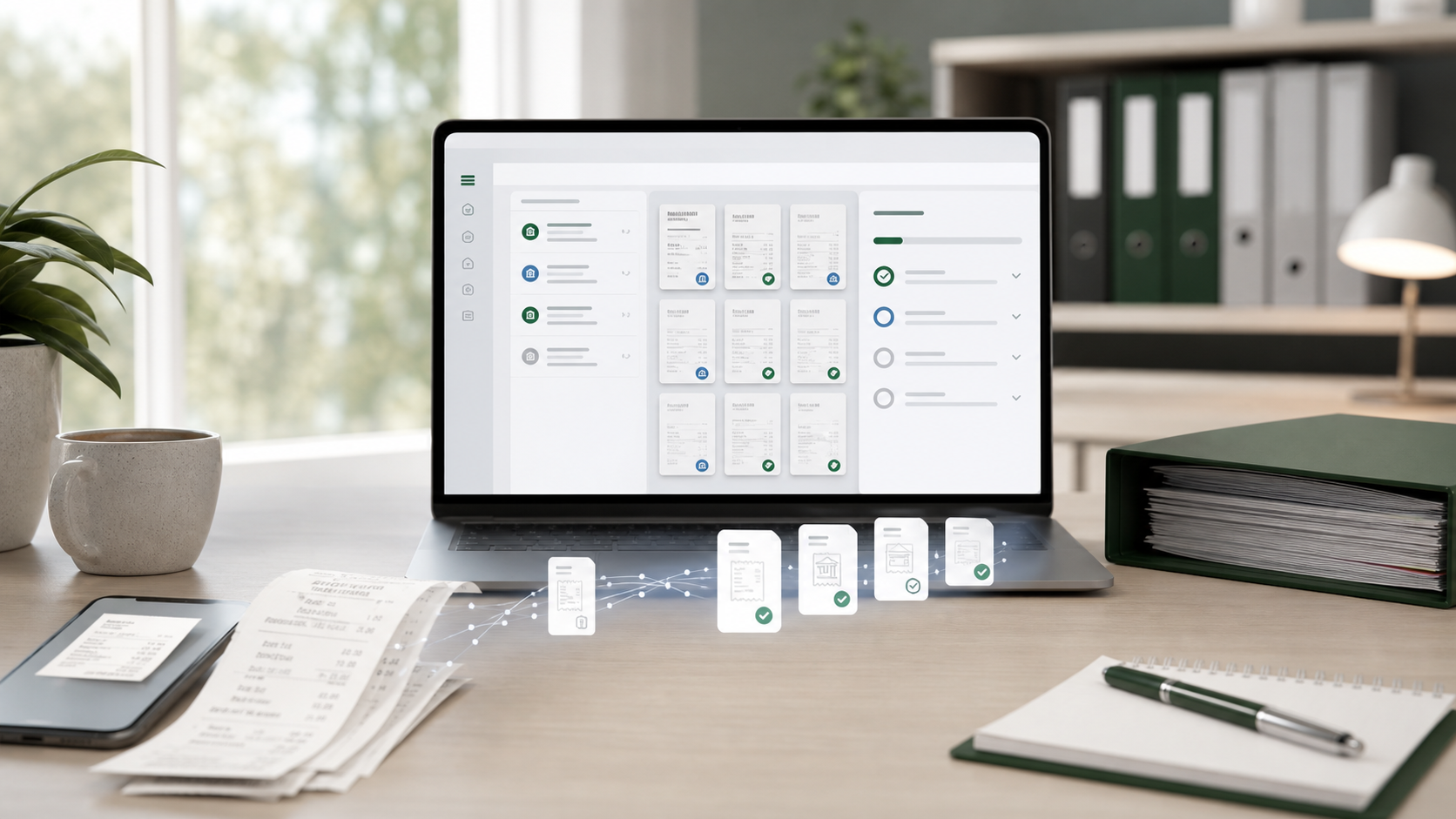
Chasing receipts does not become scalable because the reminder email is worded better. The problem is the workflow: the accountant notices a bank transaction, searches for a document, writes to the client, waits, follows up, opens the attachment and then returns to the entry.
Five minutes sounds small. Repeated 200 times in a month, it is more than two working days. A better process identifies the missing evidence from the transaction and moves the request forward without relying on the accountant’s memory.
Manual and automated workflows
| Situation | Manual pattern | Controlled workflow |
|---|---|---|
| Card payment has no receipt | Accountant discovers it during close and sends a message | The unmatched bank event creates a document request |
| Client does not answer | Accountant remembers to follow up | An open task triggers a scheduled reminder |
| PDF arrives by email | It remains in a personal inbox or is filed manually | A dedicated address routes it to the correct client workspace |
| Receipt is photographed at checkout | Image remains in the phone gallery | Mobile capture sends it directly to the bookkeeping flow |
| Forty receipts arrive together | Each is opened, read and matched separately | Bulk reading proposes matches and coding; exceptions are reviewed |
The goal is not automatic approval. The goal is to replace searching and generic reminders with specific tasks, so the accountant spends time reviewing accounting decisions.
The seven-step process
- Bank and card transactions enter the system.
- The system checks for an invoice, receipt or sufficient explanation.
- An unmatched event becomes an open task.
- The client receives a request containing the date, amount, merchant and required action.
- If the task remains open, a reminder is sent according to the firm’s policy.
- The submitted document is read and matched; an account and VAT treatment can be proposed from the client’s history.
- Unclear evidence and low-confidence proposals go to the accountant.
A useful request might say: “14 May, Verkkokauppa.com, EUR 124.90: please add the receipt or mark the purchase as private.” That is easier to answer than “Please send May’s missing receipts.”
Give clients more than one easy intake method—but one destination
Different clients prefer different actions. A sole trader may forward a PDF invoice, a field worker may photograph a receipt and a company may upload a monthly archive. Those inputs can coexist if they all arrive in the same client record and task queue.
Do not let documents remain in an accountant’s personal mailbox or WhatsApp thread. The team needs shared status, and the evidence must remain connected to the transaction after staff changes.
Mobile capture and bulk import solve different problems
Mobile capture prevents loss by recording the document immediately. Bulk import handles reality when a client still delivers many files at once. Both should feed the same matching and review logic.
When a familiar supplier and cost type recur, earlier handling can improve the proposal. A new or ambiguous merchant should receive more scrutiny, not a forced match.
Who benefits most?
- Accounting firms with many small clients: repeated five-minute tasks are removed across the portfolio.
- Toiminimi clients: requests are concrete and do not require accounting vocabulary.
- Small companies with several card users: every buyer can submit evidence to one company flow.
- Growing businesses: unresolved documents are visible during the month instead of just before the VAT deadline.
What the accountant still checks
The accountant decides whether the file is an adequate bookkeeping document, whether the purchase belongs to the business, whether VAT is deductible, whether the proposed account is appropriate and whether more explanation is needed.
Automation prepares and prioritises the work. It does not turn a bank screenshot into valid evidence or a private purchase into a business expense.
A practical pilot
Choose clients with many card purchases, chronic late material or a small fixed fee that is consumed by follow-ups. Measure missing items, reminders, days to resolution, manual handling time and the number of cases still needing an accountant. Compare the results over two or three closes.
Tulos.ai connects bank events, mobile and email documents, bulk import, targeted requests, document reading and account-coding proposals. The unresolved exceptions remain visible to the accounting team.
Summary
Receipt collection becomes scalable when every missing item is a transaction-linked task with an owner, status and deadline. Let the system detect and remind; let the client answer a precise question; let the accountant review the evidence and tax treatment.